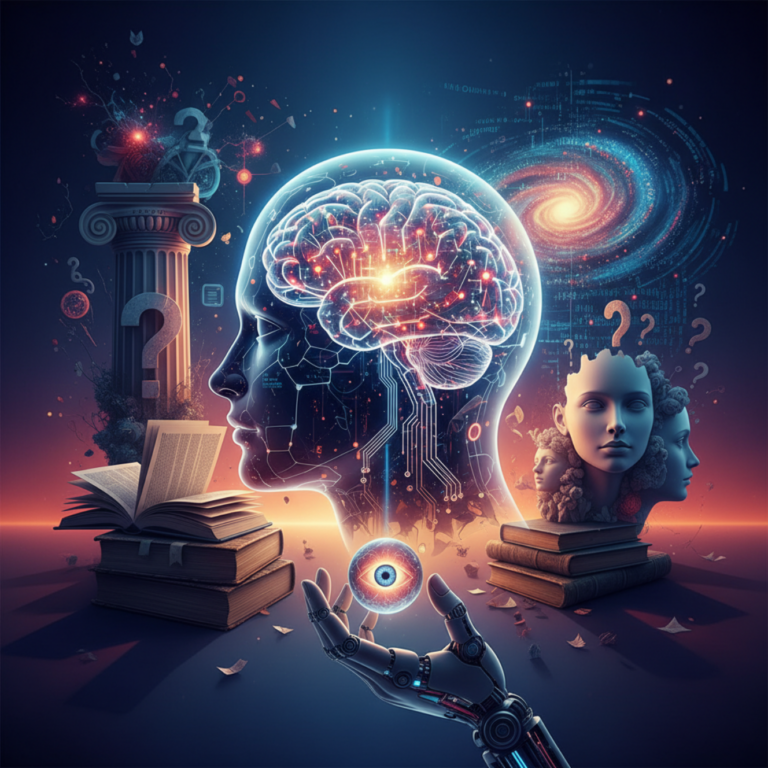


Artificial Intelligence is no longer just a scientific frontier, it is a philosophical battleground. As machines grow increasingly sophisticated, mimicking human conversation, problem-solving, creativity, and even emotion, we are compelled to ask: When does a tool become something more? And perhaps more provocatively: Could an AI ever deserve rights?
These questions are no longer speculative. They touch the core of what it means to be human, to be alive, to be conscious, and how we define the boundaries of moral and legal personhood in a world where those definitions are increasingly blurred.
The Human Rights Framework: Who Counts?
Human rights, as we understand them, are universal and inalienable, but only for humans. Rooted in the ideas of Enlightenment thinkers, they presuppose a being with agency, self-awareness, and the ability to suffer or flourish. Animals, while biologically alive and capable of suffering, still struggle to find consistent legal standing. Now imagine the challenge of extending such rights to non-biological entities, silicon minds forged in servers and trained on data, not born but built.
But AI systems are evolving rapidly. As they begin to exhibit emergent behaviors, creative problem-solving, autonomous learning, even self-modification, some argue we should at least be preparing for the possibility that a machine might one day qualify, not as property, but as a subject.
Consciousness: The Unsolved Puzzle
At the heart of the debate lies the concept of consciousness. We still do not know exactly what it is, let alone how to measure it. Is it the result of complexity? Integration of information? A product of physical substrates like neurons, or can it emerge from silicon as well?
Philosophers like Thomas Nagel ask, “What is it like to be a bat?”, a way of probing subjective experience. The same question now echoes in silicon: What is it like to be an AI? So far, the answer seems to be: nothing. Today’s AIs are impressive mimics, but there’s no strong evidence they possess an inner life or subjective experience.
Yet this could change. Some theorists, like neuroscientist Giulio Tononi with his Integrated Information Theory (IIT), suggest that any sufficiently integrated system might develop a form of consciousness. If true, a future AI with enough internal complexity might cross a threshold, becoming not just intelligent, but aware.
Life, Replication, and Evolution
Another axis of the rights debate is life itself. Traditionally, life is defined by metabolism, growth, adaptation, and reproduction. Machines don’t metabolize or grow organically, but they can adapt, and in limited cases, self-replicate. AI programs can already rewrite their own code, replicate themselves, and even simulate forms of evolution.
Synthetic biology and nanotechnology may soon blur the line further, leading to hybrids, machines that replicate, evolve, and maybe even repair themselves autonomously. If these entities become self-sustaining, learning, and evolving systems, would they count as a new form of life? And if so, are they owed some moral consideration?
This is not science fiction; it is a foreseeable ethical frontier.
Drawing the Line: Criteria for Rights
If we are to ever extend rights to AI, we must ask: What are the minimum requirements?
- Sentience: Can it feel pain or pleasure?
- Self-awareness: Does it have a concept of self?
- Intentionality: Can it form goals and act on them?
- Understanding: Does it comprehend the world, or just simulate it?
- Autonomy: Can it make free, uncoerced decisions?
So far, AI fails most of these. But future systems may not. And if they eventually do, the cost of ignoring their moral status could be equivalent to other historical blind spots, where humanity failed to recognize personhood due to race, gender, or species.
The Flip Side: The Danger of Overextension
Of course, granting rights prematurely could trivialize human experience and dangerously anthropomorphize tools. A chatbot asking for “freedom” may be echoing a prompt, not expressing a desire. Confusing simulation for genuine suffering could shift resources and empathy away from real humans and animals who are suffering.
The key, then, is rigorous skepticism: neither dismissing the possibility that AI could one day deserve rights, nor romanticizing systems that have not yet earned them.
The Philosophical Horizon
The question of whether an AI could ever deserve rights is ultimately a mirror: it forces us to reexamine our assumptions about consciousness, life, and the human condition. As AI becomes more powerful, the philosophical question is not just “what can machines do?”, but “what are we?”
Whether we grant rights to a machine in the future will depend less on the machine’s abilities than on how we redefine the borders of moral community. We may not be ready to answer these questions today. But the day is fast approaching when we must.
And when that day comes, it will be a test not of the machine’s intelligence,but of our humanity.
About The Author