

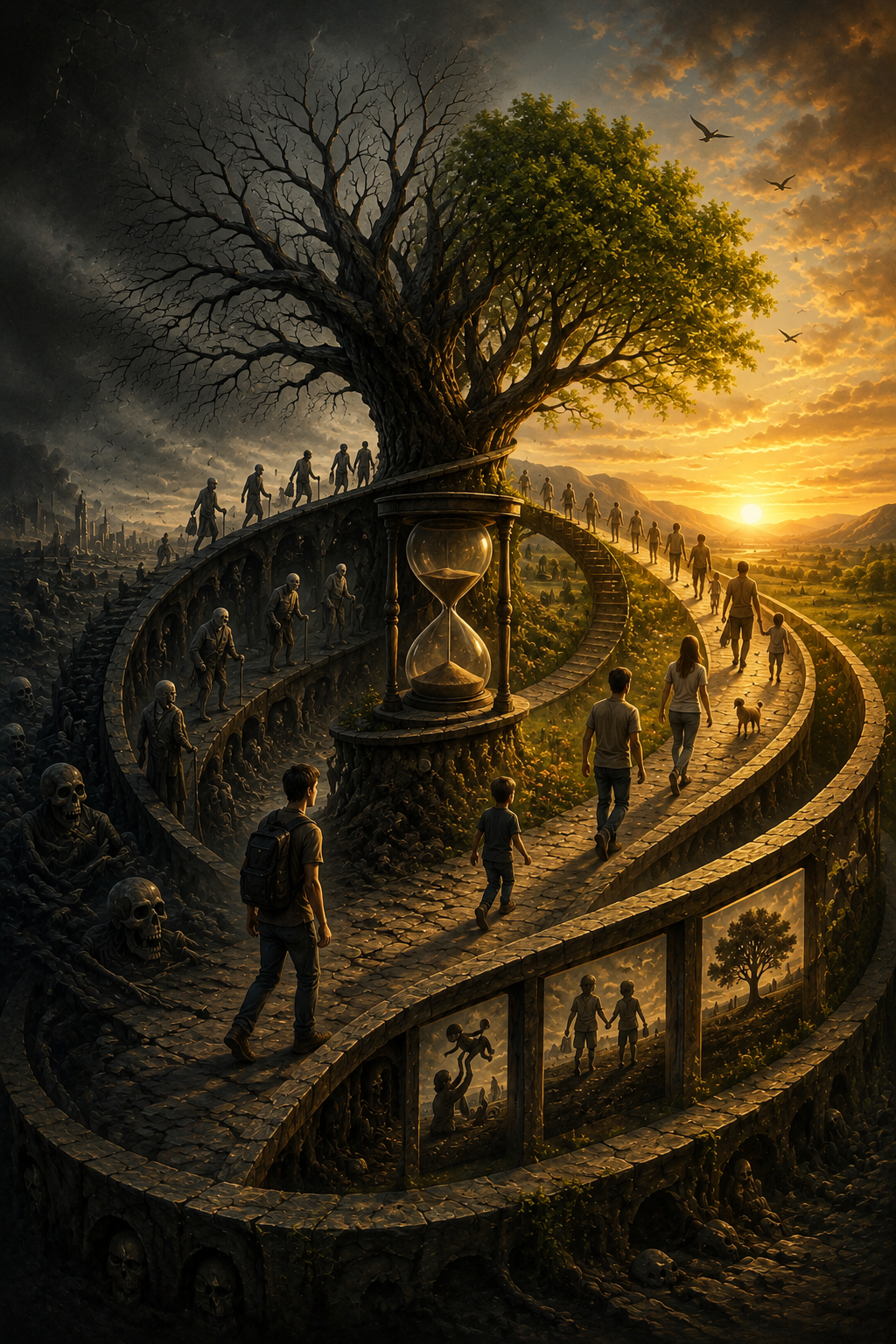
Reversibility is one of the genuine achievements of my field. Version control, feature flags, blue-green deployments, database snapshots, the humble Ctrl-Z. We spent decades making mistakes cheap, and the payoff was enormous. When failure costs little, you can try things. Almost everything good in modern software comes downstream of that single idea.
But cheap reversal does something else, and we rarely talk about it because it is not a bug. It changes how much we deliberate. If a decision can be undone at no cost, you do not weigh it. You cannot afford to: deliberation is expensive and the incentive says act now, evaluate later. That is the rational response, and it is why iteration works. It is also why nobody reads the migration plan on a system with instant rollback, and why the outages that hurt most are the ones where the rollback turned out to be theoretical.
We already know that some things are only reversible on paper. You can revert the commit, you cannot un-leak the data. You can restore the database, the customers who saw the wrong balance have already made decisions on it. Every experienced engineer carries a private list of the operations that are technically reversible and practically not. I want to suggest that a human life is mostly made of those operations, and that we are about to run a very large experiment on that assumption.
The conversation nobody is having
Longevity research is no longer fringe. Serious capital, serious laboratories, serious people. Senolytics, epigenetic reprogramming, organ replacement, none of it is science fiction any more, and I have no interest in litigating timelines.
What interests me is the shape of the public conversation, which has settled into three questions. Is it possible? Is it safe? Who gets it first? Those are good questions. But they are all questions about the procedure. Almost nobody is asking the question about the system: what is death currently doing for us that we would have to build a replacement for?That question sounds morbid. I think it is the opposite. It is the same question a careful engineer asks before deleting anything from a codebase they inherited.
The undocumented dependency
Every system that has been running long enough contains load-bearing components nobody wrote down. Not because anyone was careless, but because the component predates the documentation, or because it was so obviously permanent that documenting it seemed absurd. Nobody writes a comment explaining why the machine has power.
Then someone removes it, for perfectly good reasons, and six weeks later something apparently unrelated falls over. The failure is never where you deleted from. That is the signature of an undocumented dependency: the breakage arrives somewhere you were not looking, in a form you did not connect to the change.Mortality is the most undocumented dependency in the human system. We have never had to specify what it was providing, because it was never optional. It was infrastructure. It was the power to the building.So let me try to write some of the documentation, in the spirit of someone drafting notes before a risky migration.
Mortality is what makes prioritisation real. Choosing is only meaningful when choosing one thing costs you another. Time is our only genuinely non-renewable resource, and it is finite specifically because we die. Remove that and preferences do not disappear, but they stop being revealed by action. You would still want things. You would simply never have to demonstrate what you wanted more.
Mortality is what makes commitment expensive. A promise costs the promiser the alternatives they gave up to make it. Forever is a serious word from a being with eighty years and a cheap one from a being with eight hundred. I do not think love evaporates in a world without death, but I am fairly sure the thing that makes it count, that you are spending something you cannot get back, becomes very hard to locate.
Mortality is what forces succession. This is the argument I find hardest to wave away, because it is not sentimental and it is not hypothetical. Max Planck said that science advances one funeral at a time, and he was not being cruel. He was describing a mechanism. Institutions renew because the people running them eventually stop. Fortunes disperse. Ideologies lose their founders. We already complain about gerontocracy in politics, in academia, in boardrooms and that is under the current settings, with death still enforcing turnover on schedule. A world where power never has to change hands is not a thought experiment about individuals. It is a structural question about every institution we have.
Mortality is what gives a life a shape. Endings are not decoration on narratives; they are what makes a sequence of events into a story with a meaning. There is a reason we cannot say what a life amounted to until it stops.
The strongest objection, which I want to take seriously
Here is where I have to be honest, because the argument I have just made has an ugly history.
“Death gives life meaning” has been the consolation offered at every deathbed we could not do anything about, including all the ones we later learned to prevent. Every plague had its philosophers explaining what it was for. If mortality is what makes life meaningful, the argument proves too much: why is eighty the right number? Why not forty? By that logic, tuberculosis was a source of significance and we impoverished ourselves by curing it.
Nick Bostrom made this point better than I will in The Fable of the Dragon-Tyrant, and anyone who wants to argue the other side should read it first. The suspicion he raises is a fair one: that what looks like wisdom about mortality is usually just adaptive preference. We tell ourselves the unavoidable thing is secretly good, because the alternative is unbearable, and we mistake the coping for a discovery.
I do not have a clean refutation. What I have is a narrower claim, and I think it survives.I am not arguing that death is good. I am arguing that it is load-bearing, and that those are entirely different statements. A dependency can be terrible and still be holding something up. The correct response to “this component is causing enormous suffering” is not “therefore it must be doing nothing else.” It is: find out what else it is doing, and build the replacement before you pull it out.
Nobody is doing that work. We have people working very hard on the removal and essentially nobody working on the replacement. What replaces succession when nobody retires by force? What makes a commitment costly when time stops being scarce? What gives a life its shape when it has no ending to borrow one from?These are engineering problems. Not metaphors, actual specification problems, with stakeholders and failure modes. And there is no spec.
Why I could not leave it alone
I have written versions of this argument several times and none of them satisfied me, because the essay form keeps forcing me into a position I do not actually hold. Every draft came out sounding like I had decided. I have not decided. What I have is a suspicion that we are about to remove something without knowing what it was doing, and a genuine uncertainty about whether the suspicion is wisdom or just fear wearing a lab coat.
Fiction turned out to be the only form where I could hold both at once, where a character can be right for two hundred pages and wrong on the last one, and I do not have to adjudicate. So the long version of this argument is a novel, called Ground Zero, which is available on amazon.com, set a century into a world that made the choice and is only now reading the invoice.
But the novel is not what I want to discuss here. This is:
If you think meaning is intrinsic rather than scarce, that a life would mean exactly as much with a thousand years in it as with eighty, I would like to hear the case. It is the position I have been unable to argue myself into, and I would rather be wrong in public than confidently mistaken in private.
About The Author