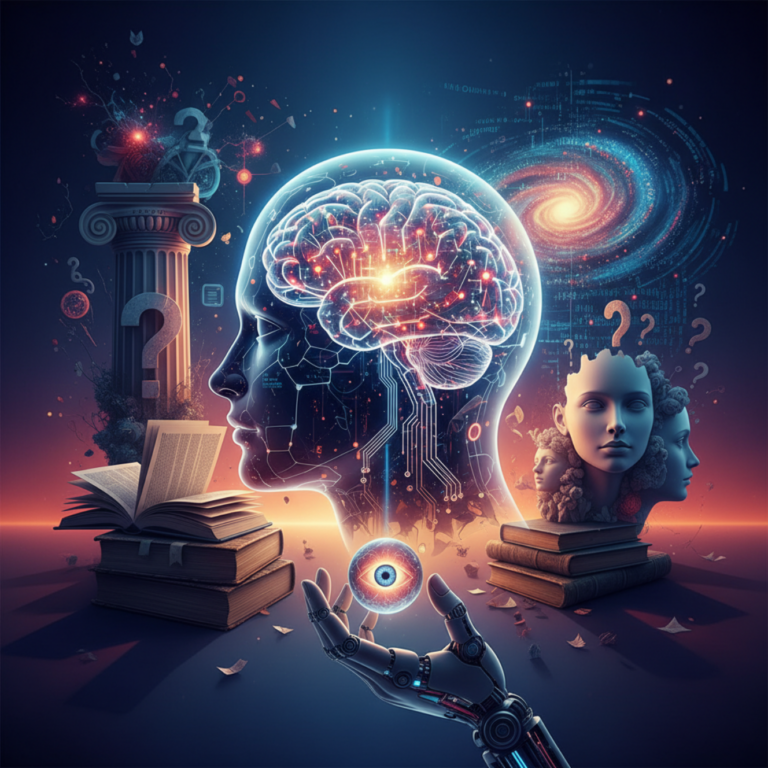


Technology is not inherently harmful. Search engines and AI can be powerful allies in learning and productivity. But when they replace thinking rather than enhance it, they become crutches rather than tools. The challenge of our time is to teach the next generation to use technology without losing the ability to think independently. Encouraging critical thinking, deep learning, and cognitive struggle, yes, even struggle, is essential.
Ultimately, intelligence is not about having access to the right answers. It is about knowing what questions to ask, and having the discipline and skill to explore them on your own. If we lose that, we risk not just a decline in IQ, but a decline in what it means to be truly human.
In an age of unprecedented technological progress, the world has become smarter, or so it seems. With the advent of search engines and now AI chatbots, information is no longer something we must store in our minds but something we summon instantly with a few keystrokes or a spoken prompt. On the surface, this transformation appears to be the pinnacle of human advancement: infinite knowledge at our fingertips, answers without effort, and decisions made in seconds. However, beneath this veneer of efficiency lies a growing concern one that educators, psychologists, and sociologists are beginning to voice more openly: the potential long-term decline in human intelligence, especially across generations, driven by our increasing dependence on machines to think for us.
From Memory to Machines: The First Phase of Intellectual Outsourcing
The shift began subtly with the rise of the internet and the dominance of search engines like Google. Suddenly, it became unnecessary to memorize historical dates, learn formulas, or even know how to spell difficult words. Why bother when the answer is only a search away? While this democratization of information broke down barriers and made learning more accessible, it also quietly redefined the nature of knowledge acquisition. The emphasis shifted from understanding to retrieving.
This transformation had a psychological cost: if information is always available, the incentive to internalize it weakens. Attention spans shortened, critical thinking skills eroded, and the depth of understanding gave way to a reliance on surface-level summaries. Studies began to show that people were becoming less likely to remember facts they could easily look up.a phenomenon known as the “Google Effect.” The first signs of cognitive atrophy were already visible.
Enter AI: The Second Phase of Intellectual Dependency
Just as society adjusted to search engines, AI chatbots arrived and elevated convenience to a new level. These tools don’t just retrieve information, they process, synthesize, analyze, and even make decisions on our behalf. Whether it’s choosing a workout plan, composing a thoughtful message, solving a math problem, or making a complex business decision, AI now offers personalized, immediate assistance that often bypasses the need for human deliberation altogether.
For the younger generation, raised in a world where AI is as natural as electricity, the temptation is enormous: why struggle to think through a problem when an AI can solve it faster and better? Why read the whole book when a chatbot can summarize it in seconds? Why develop a nuanced opinion when a bot can simulate one for you?
The Illusion of Intelligence and the Decline of Autonomy
This dependency has a deeper consequence than simple intellectual laziness, it fosters a growing inability to be cognitively autonomous. Increasingly, young people are showing signs of being less equipped to form their own judgments, solve unfamiliar problems without assistance, or think deeply about abstract concepts. If every question is answered for you and every choice optimized by an algorithm, when do you develop the muscles of independent reasoning?
Moreover, this trend can lead to a diminished sense of responsibility for one’s knowledge and decisions. When AI handles the cognitive heavy lifting, humans become passive participants in their own intellectual lives. The risk is not just lower IQ scores, but the erosion of the skills that IQ was once a proxy for: reasoning, memory, learning, and decision-making.
The Dangerous Comfort of Convenience
Convenience is addictive. When getting answers is easy, learning feels unnecessary. When decision-making is delegated, discernment atrophies. What’s worse, this decline is self-reinforcing: the less we use our cognitive faculties, the less capable we become of using them. Over time, a generation raised in the comfort of artificial intelligence may wake up to find that while the tools have grown smarter, they themselves have grown less so.
About The Author