

Skip to content

Karios

Tech news

Support me 1

Gaming History Podcast (GR)

  • Gaming History – Επεισόδιο 32 – Atari Jaguar
Primary Menu
  • Home
  • Books
  • Shop
    • Browse Shop
    • Cart
    • Checkout
    • Orders
    • Account details
    • Lost password
  • Articles
    • All Articles
    • Games
    • DIY
    • Retro
  • Gaming History Podcast (GR)
  • Contact me
  • News

Physicists think they’ve resolved the proton size puzzle

admin Posted on 7 months ago 2 minutes read
Physicists think they've resolved the proton size puzzle

​”We believe this is the final nail in the coffin of the proton radius puzzle.” 

There has been considerable debate among physicists over the last 15 years about conflicting measurements of the charge radius of a hydrogen atom’s proton—some confirming the predictions of our strongest theoretical models, others suggesting it was smaller than expected. The discrepancy hinted at possible exciting new physics. Now the debate seems to be winding down with the latest experimental measurements, described in two recent papers published in the journals Nature and Physical Review Letters, respectively. And the evidence has tilted in favor of a smaller proton radius and against new physics.

“We believe this is the final nail in the coffin of the proton radius puzzle,” Lothar Maisenbacher, of the University of California, Berkeley, who co-authored the Nature paper, told Ars.

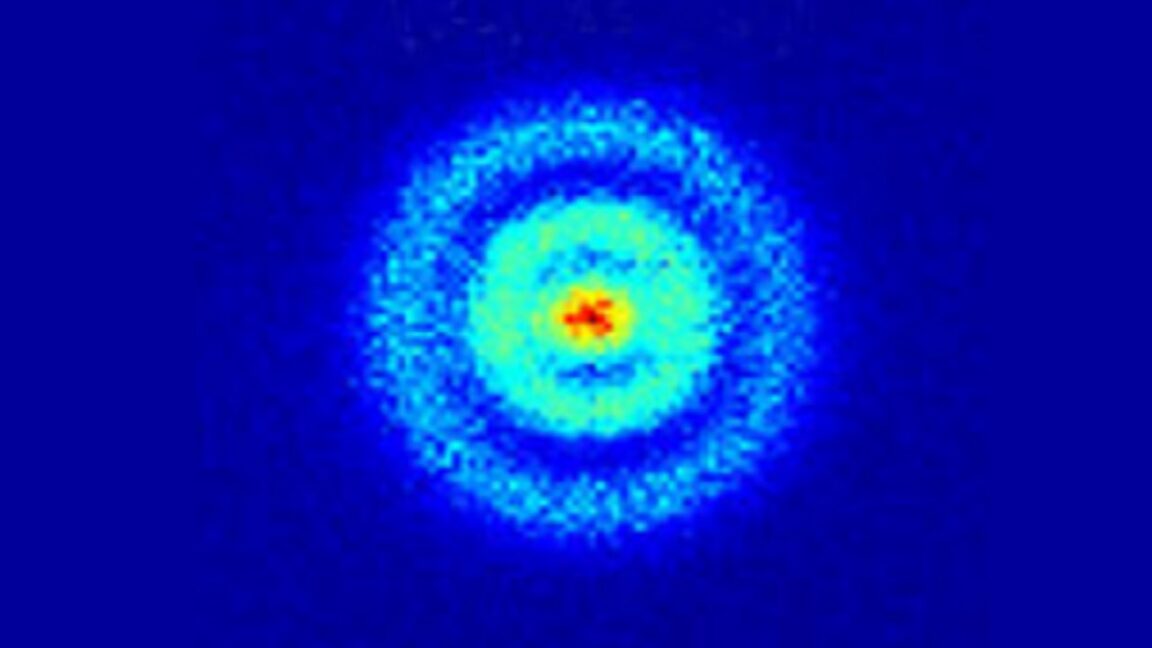
As previously reported, most popularizations discussing the structure of the atom rely on the much-maligned Bohr model, in which electrons move around the nucleus in circular orbits. But quantum mechanics gives us a much more precise (albeit weirder) description. The electrons aren’t really orbiting the nucleus; they are technically waves that take on particle-like properties when we do an experiment to determine their position. While orbiting an atom, they exist in a superposition of states, both particle and wave, with a wave function encompassing all the probabilities of its position at once. A measurement will collapse the wave function, giving us the electron’s position. Make a series of such measurements and plot the various positions that result, and it will yield something akin to a fuzzy orbit-like pattern.

Read full article

Comments

 Ars Technica – All content Read More

About The Author

admin

See author's posts

Post navigation

Previous: NASA chose the right crew to launch a new era of human space exploration
Next: Google introduces “Skills” in Chrome to make Gemini prompts instantly reusable

Related

Vulcan failure caused by inadequate fuel supply to engines, ULA says
  • News

Vulcan failure caused by inadequate fuel supply to engines, ULA says

admin Posted on 19 hours ago
Waymo has stopped its robotaxis from driving on the freeway—here’s why
  • News

Waymo has stopped its robotaxis from driving on the freeway—here’s why

admin Posted on 20 hours ago
Tesla’s $30,000 Cybercab comes with a $299 monthly catch
  • News

Tesla’s $30,000 Cybercab comes with a $299 monthly catch

admin Posted on 22 hours ago

Listen on Apple Music

You may have missed

Vulcan failure caused by inadequate fuel supply to engines, ULA says
  • News

Vulcan failure caused by inadequate fuel supply to engines, ULA says

admin Posted on 19 hours ago
Waymo has stopped its robotaxis from driving on the freeway—here’s why
  • News

Waymo has stopped its robotaxis from driving on the freeway—here’s why

admin Posted on 20 hours ago
Tesla’s $30,000 Cybercab comes with a $299 monthly catch
  • News

Tesla’s $30,000 Cybercab comes with a $299 monthly catch

admin Posted on 22 hours ago
technews
  • News

Apple Tightens Mac Privacy Controls, but AI Agents May Keep Existing Access

admin Posted on 23 hours ago

If you are located in Europe, you can buy my new sci-fi fantasy book “Ground Zero” directly from me for a better price than Amazon.