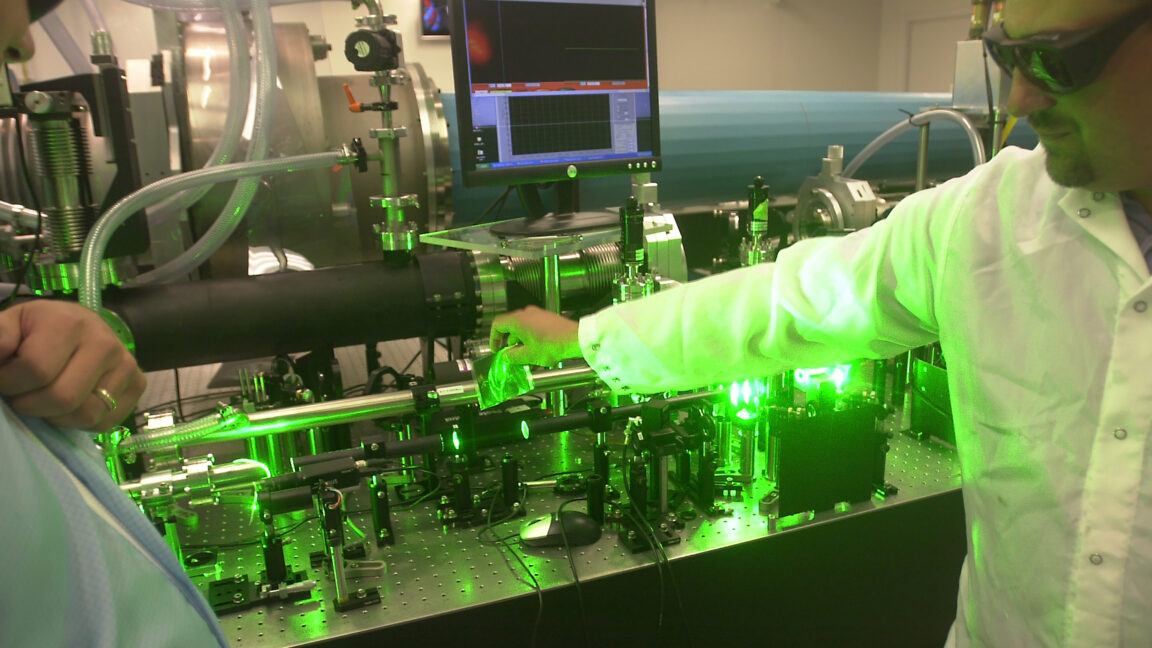
The laser was used to study the physics of stellar interiors and fusion energy, among other things.
If you walk across the open yard in front of the Physics, Math, and Astronomy building at the University of Texas at Austin, you’ll see a 17-story tower and a huge L-shaped building. What you won’t see is what’s underneath you. Two floors below ground, behind heavy double doors stamped with a logo that most students have never noticed, sits one of the most powerful lasers in the United States.
I was the lead laser scientist on the Texas Petawatt, or TPW as we called it, from 2020 to 2024. Texas Petawatt, which is currently closed due to funding cuts, was a government-funded research center where scientists from across the country applied for time to use specialized equipment. It was part of LaserNetUS, a Department of Energy network of high-power laser labs.
This type of laser takes a tiny pulse of light, stretches it out so it doesn’t blast optics to pieces, and amplifies it until, for a brief instant, it carries more power than the entire US electrical grid. Then it compresses the pulse back to a trillionth of a second to create a star in a vacuum chamber.
Ars Technica – All content Read More
About The Author