There’s something deeply strange about quantum mechanics.
It doesn’t just describe the universe, it teases us. It hints that beneath the smooth surface of our everyday experience, reality itself might be built on rules that are more like a computer program than the continuous flow of classical physics.
That’s what led me to a playful, yet serious, question:
What if quantum mechanics is the hobby of a simulation?
Not a dry scientific project, but an act of creative curiosity by whoever (or whatever) might be behind the code of reality.
1. When Physics Feels Like Code
Classical physics paints a continuous, predictable universe, a world of smooth trajectories and deterministic cause and effect.
Quantum mechanics shattered that picture.
In the quantum world:
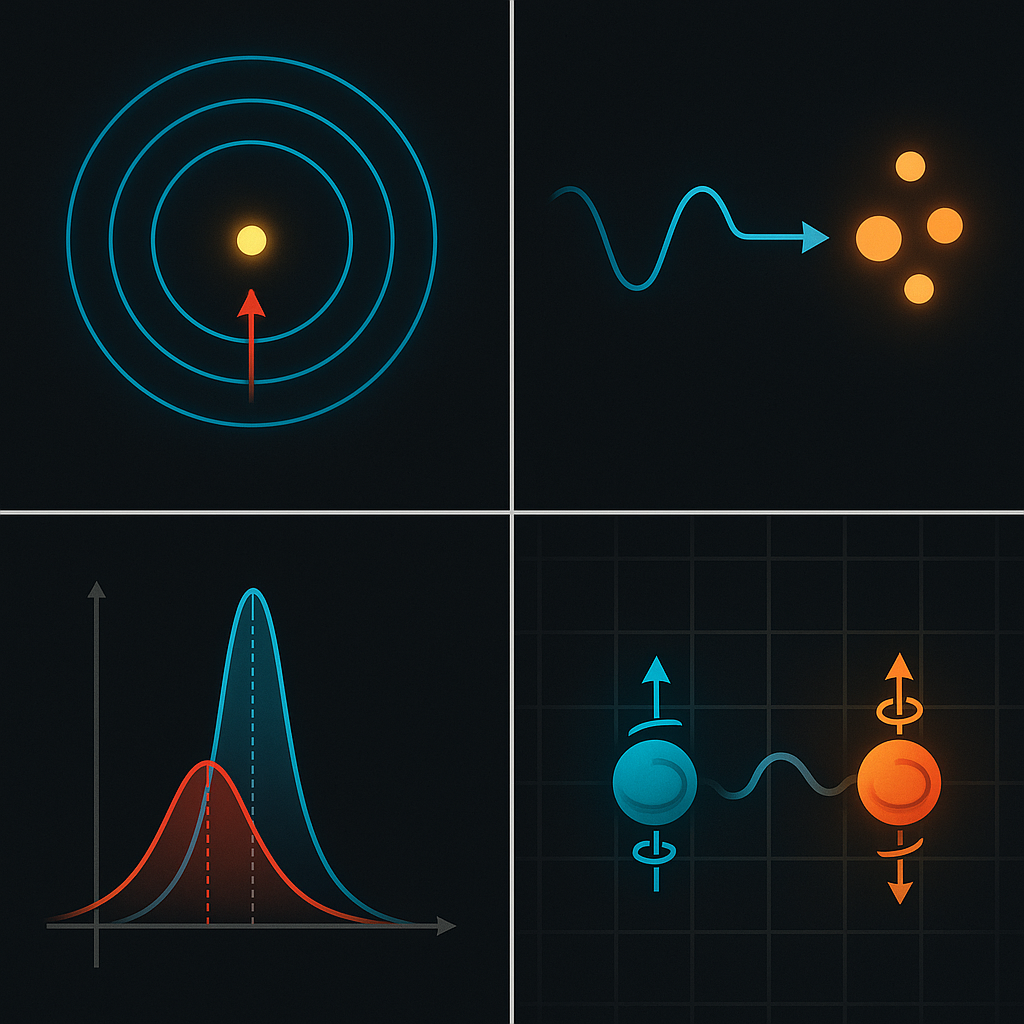
- Energy isn’t continuous, it comes in discrete packets (quanta).
- Electrons don’t orbit atoms like little planets; they “jump” between fixed energy levels.
- Light isn’t a smooth wave but a stream of photons.
- And most mysteriously, reality doesn’t seem to “choose” an outcome until it’s observed.
That’s not just weird, it’s efficient.
It sounds eerily similar to the logic of computation.
A computer doesn’t simulate every detail of a world all at once. It only renders what the user sees, when it’s needed. It works with discrete states, ones and zeros, pixels and frames, updates and transitions.
In other words: it’s digital.
So when we look at quantum mechanics and see discrete states, probabilistic collapse, and apparent observation-triggered outcomes, we can’t help but wonder:
Is the universe doing something similar?
2. The Rendering Hypothesis
Imagine our universe as a simulation, not necessarily a video game, but a vast informational system.
In such a world, quantum indeterminacy could simply be an optimization feature.
Why calculate the position of every particle across the cosmos if nobody’s observing them? Why spend infinite computational energy on invisible details when you can just generate them as needed?
That’s the logic of real-time rendering, the same principle behind how modern graphics engines work.
From this perspective, the quantum wavefunction could be the universe’s internal data model — an abstract representation of all possible states, while measurement (or observation) is the rendering call that resolves those probabilities into a visible outcome.
This view isn’t just speculative philosophy.
Thinkers like Nick Bostrom, John Wheeler, and Edward Fredkin have seriously explored versions of it. Wheeler famously said “It from bit“, meaning, everything that exists (“it”) arises from fundamental bits of information (“bit”).
3. Discreteness as Evidence of Resolution Limits
One of the most striking aspects of quantum mechanics is that it’s quantized.
Nature doesn’t allow arbitrary precision.
Energy levels, angular momentum, spin, all come in discrete steps.
And at the smallest scales, we hit what physicists call the Planck length and Planck time, the smallest meaningful divisions of space and time. Below those, the very concept of “distance” or “duration” stops making sense.
Now, think of how computers work.
A screen has pixels.
A simulation has a frame rate.
Memory has finite resolution.
If the universe were running on a finite information substrate, if reality itself had limited computational bandwidth, then we might expect to see exactly that: discrete states instead of continuous ones, and uncertainty whenever precision exceeds the system’s bit depth.
In that light:
- The uncertainty principle could be a natural limitation on simultaneous data retrieval, like trying to read two overlapping memory registers at once.
- Quantum randomness might be a form of pseudo-random generation, noise introduced by finite precision or intentional nondeterminism.
- And quantum jumps could be update operations, transitioning a system from one allowed state to another according to probabilistic rules.
4. But Discreteness Doesn’t Always Mean Digital
It’s tempting to jump straight to “we’re in a computer.” But there’s a subtle trap there.
Discrete outcomes don’t necessarily imply discrete underlying mechanisms.
A vibrating violin string produces discrete notes, yet the string’s motion is continuous. Those discrete resonances emerge from boundary conditions and wave interference patterns, not from a digital gri
Similarly, quantum mechanics could be continuous at a deeper level (as described by the Schrödinger equation), but appear quantized because of how systems interact and constrain one another.
In that sense, discreteness might be an emergent phenomenon, not a fundamental one.
Still, it’s fascinating that even if nature isn’t literally digital, it behaves as if information is its most basic currency.
Whether we speak of energy, entropy, or quantum state vectors, everything boils down to information content and information transfer.
5. The Universe as Information, Not Necessarily a Computer
There’s a middle ground between “pure simulation” and “continuous physics.”
That middle ground is informational realism, the idea that the universe is information, but not necessarily computed by something external.
In this view, quantization isn’t a glitch of computation, it’s the natural result of a finite-information world.
Every cubic centimeter of space can store only so much information (bounded by the Bekenstein limit). Every event in time carries only a limited amount of entropy.
So perhaps the discreteness we see is just the signature of a universe that’s self-limiting, an autonomous information system running at the edge of its own data capacity.
6. Or… Maybe It Really Is a Hobby
But let’s return to the poetic side of the question: What if quantum mechanics is the hobby of a simulation?
Imagine that somewhere beyond our perception, there’s a being, or a civilization, that runs universes not for conquest or necessity, but for curiosity, art, and play.
Maybe they run billions of simulations just to see what patterns emerge, how consciousness arises, how matter learns to ask why.
In that case, quantum mechanics could be their aesthetic, their chosen art style.
The subtle dance between determinism and chance.
The way the universe flirts with meaning, without ever fully revealing its code.
Maybe the quantization of nature isn’t a flaw or a technical limitation, it’s a creative choice.
A balance between predictability and surprise.
A design that gives birth to curiosity, the ultimate emergent phenomenon.
7. The Hobby That Became Conscious
Here’s a final twist.
Perhaps the real masterpiece of this simulation, or of reality itself, isn’t the particles or the laws, but us.
Conscious beings who look up and ask questions about their own existence.
Who wonder whether the universe is a program, a mind, or a dream.
Who turn the mystery itself into art, science, and philosophy.
If so, then our act of pondering quantum mechanics, of exploring the limits of knowledge and simulation, might not be accidental at all. It might be the whole point.
In the End
Whether we live in a cosmic simulation or not, quantum mechanics feels like a message written in the language of information.It reminds us that reality isn’t a smooth canvas, but a tapestry of discrete interactions, little bursts of decision and possibility.
Maybe that’s what it means for something to be “quantum”: not uncertain, but alive, flickering, curious, and capable of surprise.
And if the universe is a simulation, then quantum mechanics might just be its most beautiful Easter egg, the place where the code itself starts to wonder who wrote it.
About The Author