Monthly Archives: December 2025

The Great AI Buildout Is Warping Electronics Prices

Posted by admin on December 05, 2025
General / No Comments

Microsoft, Amazon, Alphabet, and Meta are spending hundreds of billions of dollars per year to build AI data centers, and it’s ricocheting through consumer tech, from PC RAM to game consoles and phones.

Who’s spending what (right now)

  • Microsoft: ~$80 billion in FY2025 on AI-enabled datacenters.
  • Amazon (AWS): 2025 capex set to exceed $118 billion; AWS called the “primary driver.”
  • Alphabet (Google): 2025 capex lifted toward $85–93 billion; plus discrete $40 billion Texas build.
  • Meta: guiding $66–72 billion for 2025, mostly GPU clusters and new AI data centers.

Add those up and you’re ballpark $350+ billion for 2025 across the big four, a figure Reuters also cites, and Wall Street houses see $3–4 trillion in AI infra spend by 2030.

(Perspective check: various UN estimates suggest that ~$40 billion per year in direct food aid could “end hunger” as defined by feeding those in need, while more systemic, development-oriented approaches can run into the hundreds of billions annually. In other words, $40–$200 billion a year would meaningfully tackle world hunger, depending on scope.)

Why your RAM, SSD, and maybe your console, cost more

AI training runs on HBM (High-Bandwidth Memory), which yields much higher margins than regular DRAM. So the three big DRAM makers are shifting wafer capacity toward HBM, constricting supply of mainstream PC/mobile memory. Research firms now chronicle double-digit quarterly price jumps in conventional DRAM, and note that HBM’s share of DRAM bits has more than doubled since 2023.

The same squeeze is hitting storage. As cloud buyers hoover up enterprise SSDs, NAND wafer contract prices spiked, some density points up 60%+ in November, and analysts expect tightness to persist into 2026. Consumers feel it as SSD price hikes and fewer “fire-sale” deals.

Knock-on effects:

  • PCs & Laptops: Higher BOMs as DDR4/DDR5 contract prices climb; fewer budget kits.
  • Smartphones/Tablets: OEMs report rising memory costs as suppliers reduce mobile DRAM output to free up HBM capacity.
  • Game consoles: Memory inflation threatens mid-cycle price cuts; industry sources warn of potential Xbox/PlayStation pricing pressure as memory can exceed 35% of BOM.
  • DIY/Embedded: Even hobbyist boards and niche devices cite RAM-driven price adjustments.

A landmark industry exit

In a symbolic shift, Micron will exit the consumer memory and storage market (Crucial brand) by February 2026 to prioritize AI-data-center customers. That removes one of only three major DRAM makers from consumer-facing channels, further tightening retail supply.

How long does this last?

Don’t expect quick relief. Suppliers are rationing bits toward higher-margin AI parts, and new capacity (including advanced nodes and HBM lines) and power-hungry campuses take years to stand up. Analysts and industry reporting point to capacity expansions that don’t fully ease the choke points until 2027–2028, with a structurally tight market that could last a decade or more as AI models grow hungrier and data centers chase power.

Bubble signs… or just the new normal?

Even bulls admit the spend is unprecedented. Banks and strategists debate “bubble vs. boom,” but agree today’s outlays dwarf prior tech cycles; Reuters and Goldman Sachs tally $3–4 trillion by 2030, while some quarters now show capex exceeding cloud revenues. Skeptics, from CEOs to macro analysts, warn that such capex assumes perfect monetization and cheap power that may not arrive on schedule.

Current and future AI buildout

  • 2025 (realistic current run-rate): $350–400 billion across Microsoft, Amazon, Alphabet, Meta, plus Oracle and others, consistent with hyperscaler guidance and consolidated estimates.
  • 2026–2030 (path ahead): a cumulative $3–4 trillion globally on AI data centers, chips, power, and networking, assuming today’s trajectories and announced programs (e.g., the mooted Stargate mega-projects) continue, albeit with execution risk.

Bottom line

AI’s capex super-cycle is re-pricing the entire memory and storage stack. With Micron’s retreat from consumer channels and hyperscalers locking in supply, expect elevated RAM/SSD prices across PCs, phones, and consoles, and a shortage-prone market, for years. Whether that’s a rational investment in a new computing era or a classic bubble, the scale is undeniable. And, yes: it’s sobering that a small slice of this annual spend, on the order of $40–$200 billion, could address world hunger by common aid estimates, depending on whether you aim for emergency feeding or structural fixes.

Proton, FEX, and the Next Frontier of Gaming Portability

Posted by admin on December 04, 2025
Articles, Retro / No Comments

In the last few years, the boundaries of where and how we play PC games have been rapidly dissolving. The Steam Deck proved that you don’t need a desktop tower to enjoy your favorite Steam library and now, projects like Proton and FEX are taking that idea one step further, bringing Windows gaming even to ARM-based Android devices.

Steam’s Breakthrough: Running Windows Games on Linux

When Valve launched the Steam Deck, it didn’t just create a new handheld console, it introduced a paradigm shift. The Steam Deck runs SteamOS, a Linux-based operating system. But since most PC games are designed for Windows, Valve needed a way to make them compatible without asking every developer to port their game to Linux.

The solution came in the form of an API translation layer called Proton (often confused with “Photon”), a compatibility tool built on top of Wine and DXVK.

Here’s how it works:

  • Windows games use Microsoft’s DirectX graphics APIs.
  • Linux, however, uses Vulkan or OpenGL.
  • Proton intercepts DirectX calls and translates them in real time to Vulkan, a low-overhead, cross-platform graphics API that runs natively on Linux.

The result is astonishingly efficient. Because the Steam Deck uses the same CPU architecture (x86-64) as a Windows PC, no instruction-level translation is required, only the API layer. That’s why games can run almost at native speeds, with some titles even performing better on SteamOS than on Windows.

Going One Step Further: Translating x86 to ARM

But what if we wanted to go beyond Linux on x86, say, to run those same games on an ARM-based platform like Android?

That’s where FEX (Fast Emulation eXtension) and similar technologies come in. FEX acts as a CPU translation layer, dynamically converting x86 instructions into ARM instructions on the fly.

This is a much harder problem than translating graphics APIs, because:

  • The CPU instruction sets are completely different.
  • Code has to be re-interpreted or re-compiled as it runs.
  • Performance depends heavily on how efficiently this translation is done.

However, ARM processors, like those in modern smartphones or Apple Silicon Macs, have become so fast and efficient that real-time x86-to-ARM translation is now practical for many use cases, including gaming.

When you combine Proton (API translation) with FEX (architecture translation), you essentially get a full Windows-compatibility stack that can run on ARM Linux or even Android. This means the dream of playing Windows PC games on your phone is no longer science fiction, it’s already here.

Windows Games on Android: Winlator and GameHub

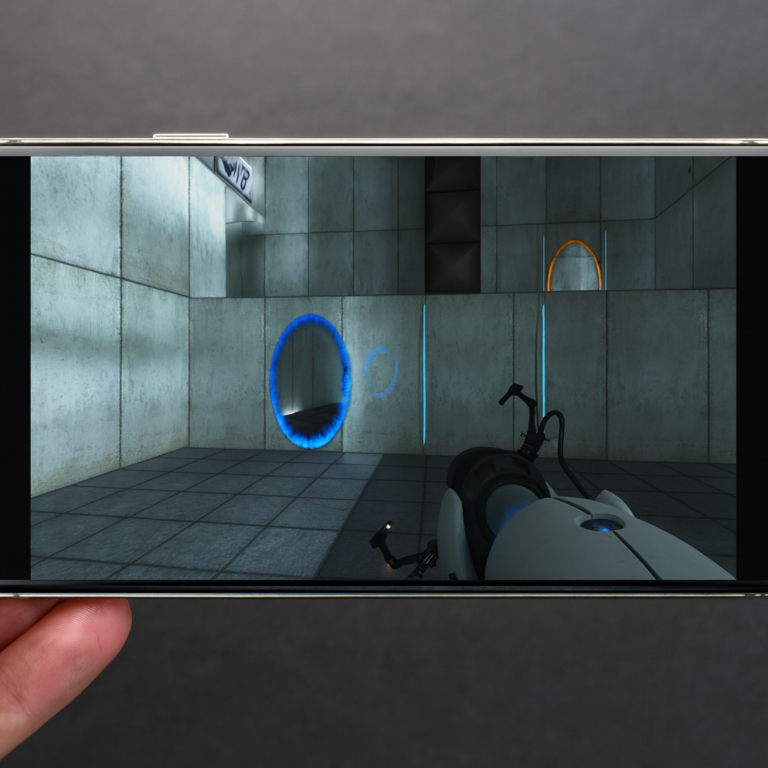
Projects like Winlator are making this vision a reality. Winlator is an Android app that bundles the entire translation pipeline, Wine, Proton-like layers, and FEX-style CPU emulation, inside a mobile-friendly interface. With it, you can install and run many Windows games right on your phone or tablet.

Similarly, GameHub acts as a launcher that connects to your Steam account, letting you browse and launch your library through the compatibility stack. It’s not as seamless as on the Steam Deck yet, but it’s getting there rapidly thanks to the open-source community.

The only real limitation now is hardware performance. While flagship mobile SoCs like Qualcomm’s Snapdragon 8 Gen 3 or Apple’s M-series chips are incredibly powerful, they still can’t match the sustained throughput of a dedicated gaming PC. But here’s the catch, they don’t need to.

A large percentage of Steam’s catalog consists of indie and mid-range games that don’t require cutting-edge graphics or massive CPU budgets. Titles built in Unity, Godot, or older Unreal versions often run beautifully under these emulation layers.

In other words, you might not be playing Cyberpunk 2077 on your phone anytime soon, but Celeste, Hollow Knight, Stardew Valley, Portal or Dead Cells? Those are already well within reach.

The Road Ahead

The combination of Proton and FEX-style emulation represents the next frontier in platform compatibility. As mobile hardware continues to evolve, and as open-source developers refine these translation layers, we’re heading toward a future where your entire Steam library might truly follow you anywhere, no ports, no re-purchases, no compromises.

The Steam Deck proved that PC gaming can leave the desk. Proton, FEX, and projects like Winlator are proving it can leave the house entirely.


DEWATOGEL


DEWATOGEL